
The digital currency, which has experienced a spectacular upswing trend in recent years, is increasingly affecting the world economy. Consumer shopping habits, new buying methods and developments in digital currency seem to make them indispensable in the coming days. In its basic sense, it is possible to express the digital currency as a virtual concept hidden behind a set of cryptography, which is actually called "crypto money", which depends on mathematical operations, which is very difficult and expensive to achieve. However, with the development of the Internet, purchasing decisions are increasingly moving toward digital platforms, meaning that the habit of using and evaluating money is gradually shifting to the digital world, and the region is beginning to lay the groundwork for the economic system. In this article I will also talk about a new centralized approach that makes block chains called Cardstack available and scalable for mass market. For more information you can visit https://cardstack.attach.io.
Understanding About Cardstack?
Cardstack is an open-source framework and consensus protocol that creates a centralized software ecosystem that can challenge today's super-power digital, making block chains workable and scalable for mass market.
In other words, Cardstack makes the leap for block chains on every floor of the software pile, adding revolutionary experiences that make block chains technology workable and measurable; creating a centralized software ecosystem that can match the digital platform. Centralized technology drives us to silos and captures the value we create. Early centric technology, such as bitcoin, promises chaining blocks, but also benefits the bad guys.
The Cardstack decentralization approach allows dominant users to act as their center; so that interactions with applications and services running on different network topologies flow through user-controlled software stacks.
The concepts that make up this field problem are mainly:
The App Store Period turns the software feature into an independent, original application; These apps generally do not communicate with each other, others want to choose from some overlapping features to shape the user's workflow.
While the software is floating in the cloud, the user has to manage multiple subscriptions to the software product (SaaS) as a cloud-based service and choose the right plan to optimize the cost for all the required features.
The emergence of block chains and decentralized applications (dApps) has made it difficult for users to obtain and manage service symbols for every function that makes up the software stack. In the Cardstack approach.
Directing the vertical silo to the horizontal layer, which is a layer of decentralized Internet experience, enables local applications, cloud applications, and dApps chaining chains into a pile of future software that combines the best features of any approach to the age of the software.
In addition, the combination of a decentralized Internet experience, blockade tools, cloud-savvy devices and users has learned to work with multiple applications across devices, clouds and block chains to fully meet their needs. Human creativity will continue to close the gap left behind by technology.
Cardstack solutions in this regard are:
Cardstack creates a new layer of experience that helps users manage their interactions in Apps (d) while maintaining collective market acceptance of epistemic centralized technology in open ecosystems.
In short, the new orchestration approach should put users at the center and let them act like their own center; so that interaction with applications and services occurs through user-controlled stack software.
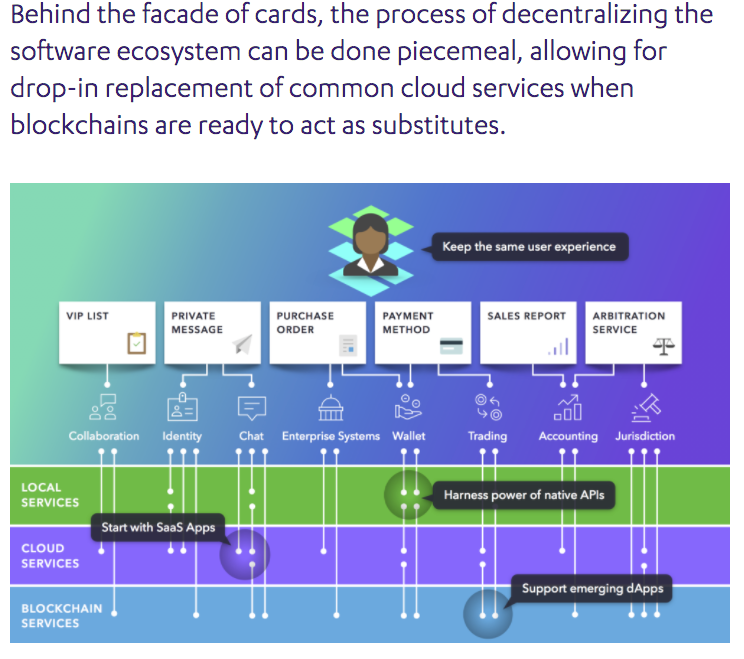
Additionally, the settings necessary to coat a decentralized Internet experience can be intuitively done by suggesting the flow of subsequent movements by chaining each card by changing every state of the application into a visual setting of the relevant information.
The process of centralizing the software ecosystem behind a stack of cards experiencing a centralized Internet experience can be done piecemeal by letting the general cloud service change when ready to change the block chain.
Business card features
With Cardstack, end users can mix and match features from multiple applications or DAPP without worrying about the complexity of separate cloud subscriptions or service markers. Even more interesting: this system allows users to design new, very new workflows to participate in services from different layers of the Internet; this would not be possible in a centralized world.
The invention is made possible by an associative design paradigm that makes Cardstack an expandable, embedded, embedded, chained, triggered, diversioned, cloned, approved, revoked, or permanently recorded unit into one-piece encapsulated card. In a decentralized world, your data must be networked or sovereign as you wish.
Developers can use Cardstack Framework, a comprehensive SDK to create powerful card-based blockage applications. Build anything by using modular stories and discovery containers. Easily create custom workflows using Cardstack Hub, which organizes data transfers and values across multiple chain blocks and clouds. Use prebuilt functions like searchable index, real-time notifications, uniform user permissions, flexible container distribution and more. Everything is upgraded and 100% open source.
When a user uses CARD, he creates a smart contract between the user and the selected app before entering the prize pool. Based on anonymous usage data tracked by smart contracts, collected icons are then distributed regularly to content creators and app contributors according to the algorithmic payment model and dynamic governance at the hands of the community.
Like other crypto currencies, CARD users can become miners to verify transactions and earn wages. However, unlike Bitcoin, which forces miners to solve math problems that do not work, Cardstack's analysis miners made the system fair and flexible by helping calculate reward functionality who pay whatever it takes to generate unwanted mail. The results of analytical miners compete in a ranking scheme called analytical evidence, so the award algorithm has never been under the control of one party.
For end users
Mix and match multiple dApps and cloud applications
Create amazing workflow and amazing new app combinations using Cardstack Hub.
Use a token (CST) that creates a custodial agreement with all the services you need to let your data dominate or be easy to reach with our card-based user experience quickly starting with Fiat currency: no cryptographic expertise required.
For developers
Use a comprehensive SDK to create great and beautiful apps
Library access in powerful pop-up functionality
Fix your app experience using Cardstack's off-chain aggregation is fairly paid by Community-managed payment and governance algorithms.
Get a refund for your material costs.
Keep things 100% open source.
For analytical miners do useful work for algorithm-based empowerment, which provides a fair distribution of wealth
Helps protect the system from extremes, malicious offenders and spam
Filling as an eBoard Card that can be rolled back into the eco system
Offset by a ranking scheme that prevents the only party who controls the reward function
Cardstack provides a set of tools that unlock the decentralized Internet potential for everyone - a leap for block chains on every floor of the software pile.
Cardstack Framework is a comprehensive SDK for creating powerful and consistent blocking applications. Essentially, there is a Cardstack Hub that manages the transfer of data and values on several chain blocks and clouds.
Negotiation protocol
Card powered DApps can touch the Tally protocol, which gives DAPPS the power to make complex calculations for managing large user networks, such as collecting payments, counting votes, and rewarding good work.
Ecosystem Tokens
Developers can get Cardstack-based applications through smart contracts supported by Cardstack Token (CST), the Ethnicum-based ERC20 symbol, designed to give a fair appreciation to Cardstack-based communities.
Card Token Promotion
This is the catalyst for the global movement toward a sustainable software market built on open source code supported by the crypto economy. The Card Token Details are under the last review and will be published shortly. This includes information on pre-allocation criteria and a busy fundraising mechanism.
Development

For more details, please visit the following website.
https://cardstack.com/
https://medium.com/cardstack
https://t.me/cardstack.
https://cardstack.com/whitepaper-pdf
https://facebook.com/cardstackproject
https://bitcointalk.org/index.php?topic=2805234.new#new
https://telegram.me/cardstack
https://github.com/cardstack/cardstack
https://twitter.com/cardstack
Author: koeskoesnadi
bitcointalk profile: https://bitcointalk.org/index.php?action=profile;u=1702011
ETH Address: 0x111cf590EFeBD57d2144639aB1331Eb5e20712C4



Tidak ada komentar:
Posting Komentar